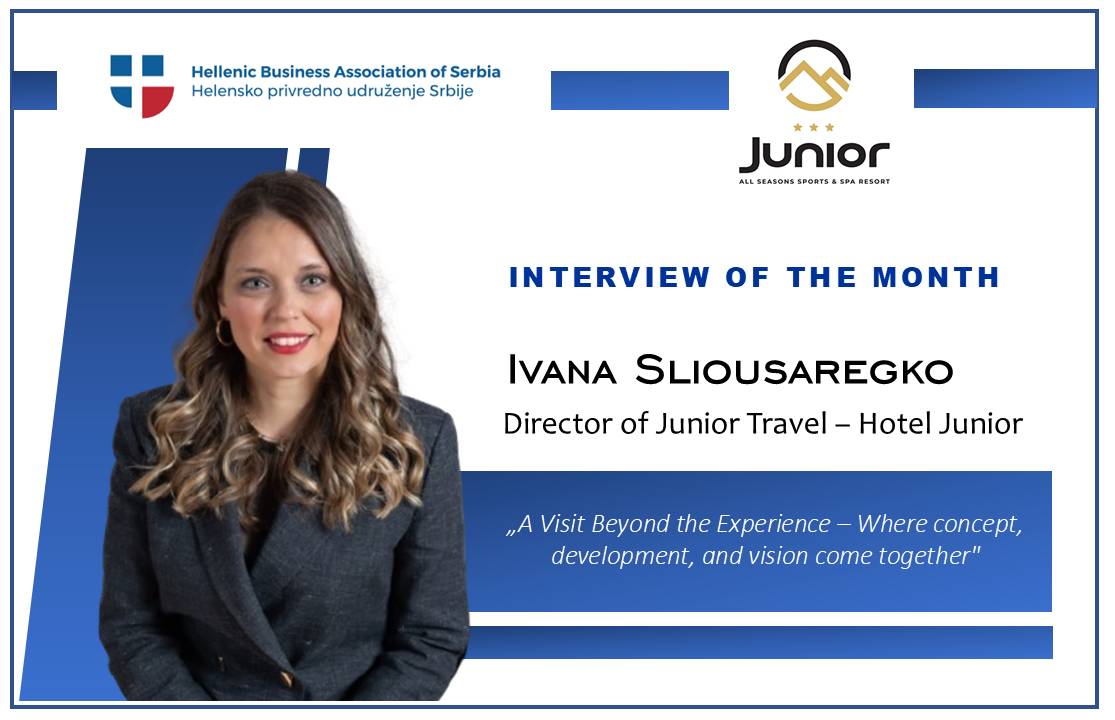
INTERVIEW OF THE MONTH: HOTEL JUNIOR
A VISIT BEYOND THE EXPERIENCE
Ivana Sliousaregko, Director of Junior Travel - Hotel Junior
"Continuous investment in employee development, improvement of internal procedures, and fostering a culture of responsibility and teamwork enable us to maintain consistent service quality, regardless of the guest structure. This synergy of experience, knowledge, and organization represents one of the key drivers of our long-term success".
Hotel Junior positions itself as more than just a hotel, but a destination. What does that concept mean in practice for your guests?
The concept of a destination in tourism primarily refers to a space that offers attractions, appropriate infrastructure, and accommodation capacities that attract visitors. This is exactly what Junior represents—a complex that functions as a well-rounded tourist destination through its facilities and overall offering. From the very beginning, the idea behind the hotel was to bring together guests whose primary motivation is engaging in a variety of activities and enjoying an active holiday. The accommodation unit itself has never been perceived as the main attraction, but rather as part of a broader experience. The key reason guests choose Hotel Junior lies in the diversity of facilities within the complex, as well as the activities available in its immediate surroundings.
Following the hotel’s privatization in 2006 and the establishment of a new team in the years that followed, the strategic focus was directed toward enhancing additional amenities. A conscious decision was made not to prioritize upgrading the hotel’s category, but instead to focus on developing and enriching the overall offering of the complex. This is precisely what makes us a unique property in Serbia. It is this diversity of content and richness of the overall offer that position Junior as a recognizable destination in the eyes of guests and represent the key factor in their decision to choose us for vacation, recreation, and stay.
Since the privatization in 2006, the hotel has undergone significant development—and you have been part of that journey almost from the very beginning. From your perspective, what were the most important milestones in that transformation?
The transformation of a company from state-owned to privately owned involves multiple stages, but it can generally be divided into adjustments and changes across three key areas.
The first step involved aligning documentation. When taking over the business records of a state-owned company at that time, it was common to encounter a large number of unjustified contracts, decisions, and invoices. An even greater challenge was the absence of certain documentation necessary to ensure compliance of business processes with current legal regulations. This issue became particularly evident during inspections, as it was not possible to have full visibility of all potential shortcomings at that stage.
The second step focused on employees. First and foremost, the number of employees significantly exceeded actual operational needs. After a detailed assessment, those who demonstrated readiness to continue working in the new business environment were retained. It was necessary to adapt their mindset to new rules, standards, and operational procedures. Building team spirit, establishing shared goals, and developing individual responsibility was a process that took several years. Through joint effort, standards of conduct and service quality were established, along with procedures that continue to be continuously improved and adapted.
The third, very important area was adapting guests to the new circumstances. Renovation of the facility after privatization, along with improvements in amenities, led to changes in pricing policy. Therefore, it was necessary to meet and justify guest expectations through a higher level of service and overall quality.
This process was neither simple nor quick, but thanks to collective effort and careful selection of people, it resulted in outstanding outcomes. We are particularly proud of the fact that a large percentage of our employees have long tenure within the company, and that approximately 70% of our guests are returning visitors. This clearly confirms that the right development path was chosen.
Hotel Junior hosts a wide range of guests, including children’s excursions, sports teams, and corporate team-building events. Based on your experience, how do you adapt your services to meet the needs of such diverse groups?
I believe that the key factor behind successful adaptation lies in our employees, who are fully aligned with the defined goals of excellence in hospitality. Their dedication, experience, and commitment to continuous improvement have enabled not only the implementation of changes, but also their long-term sustainability. Given that we host different categories of guests, it is essential that both the approach and the quality of service match their expectations. Flexibility, understanding of diverse needs, and the ability to adapt quickly in daily operations represent key strengths of our team. Each of these guest groups arrives with specific requirements, of which our employees are fully aware. Thanks to strong feedback from the sales team, as well as continuous communication between departments, staff are well-informed about guest expectations. Their long-standing experience further enhances their ability to respond adequately to different situations and deliver a high level of service.Continuous investment in employee development, improvement of internal procedures, and fostering a culture of responsibility and teamwork enable us to maintain consistent service quality, regardless of the guest structure. This synergy of experience, knowledge, and organization represents one of the key drivers of our long-term success.
The hospitality market on Kopaonik is becoming increasingly competitive. How does Hotel Junior differentiate itself and stay competitive among other hotels and resorts?
At the risk of sounding overly confident, I believe that Hotel Junior has no direct competition, both on Kopaonik and in the wider region. This statement does not stem from the assumption that Junior is the best hotel in terms of accommodation standards or luxury. On the contrary, Kopaonik is home to many outstanding properties and highly professional management teams that continuously contribute to the development and overall image of the destination. However, the key difference lies in the concept and structure of the offering. Junior is not positioned merely as a hotel, but as a complex that functions as a destination in itself. Its value is not based on a single segment of service, but on the overall experience it provides to guests. The diversity of facilities—sports, recreational, social, and leisure—forms the foundation of its differentiation and long-term competitive advantage. Unlike modern investment trends, which often prioritize maximum land utilization and focus primarily on accommodation capacities, Junior has been developed with a different philosophy. A significant portion of the space is dedicated to amenities that enhance the quality of stay, both outdoors and within the complex. This creates additional value for guests, extends their length of stay, and increases overall satisfaction. It is also important to highlight that the concept of shared spaces and activities is actively nurtured within the property—something that is increasingly rare in modern hotel developments. This approach enables the creation of a dynamic and engaging environment tailored to different guest profiles, from individuals and families to organized groups and sports teams. This combination of diverse facilities, spatial organization, and long-term development makes Junior a unique complex that is difficult to directly compare with other properties on the market. It is worth noting that similar concepts existed in the past; however, many of those properties did not continue to evolve, which led to a gradual loss of their market position. Nevertheless, tourism is a dynamic sector, and the emergence of new investments or revitalization of existing ones may influence competition in the future.
What are the key plans for the future development of Kopaonik, particularly in terms of skiing infrastructure, winter tourism, and enhancing the overall experience for visitors during the ski season?
The development of a mountain destination is a complex and long-term process that requires a clearly defined vision. Investments cannot be short-term; they must be strategically planned and implemented in phases. In this context, the public enterprise Skijališta Srbije has a highly responsible role. One of the main challenges is the decrease in natural snowfall due to climate change, which increases the importance of artificial snowmaking. The construction of an accumulation lake has largely resolved previous water shortages, enabling more stable operation of ski slopes. Significant investments have already been made in this area. Future priorities include modernization and expansion of ski infrastructure, replacement of outdated installations, and increasing capacity. Overcrowding on ski lifts, especially during peak periods, directly affects guest satisfaction and highlights the need for further investment. Equally important is the development of summer tourism. Long-term sustainability cannot be achieved if the destination operates only in winter. Investments in year-round attractions—such as adventure parks, alpine coasters, zip lines, and biking trails—are crucial. The future of Kopaonik lies in balancing winter and summer offerings and creating a year-round destination that meets the expectations of modern travelers.
You are a long-standing and active member of the HBA. What does the Hellenic Business Association represent for you, and are you satisfied with its work?
As a long-standing and active member of the Hellenic Business Association, I see HBA as an important platform for networking, exchange of experiences, and improvement of the business environment. Through its activities, HBA successfully brings together companies and individuals who share similar values and interests, creating space for dialogue, collaboration, and new business opportunities. I would particularly highlight the importance of events, educational initiatives, and networking opportunities, which allow members to stay informed about market trends and actively contribute to shaping them. Additionally, HBA plays a key role in strengthening economic ties between Serbia and Greece. I am very satisfied with the work of HBA. The organization demonstrates professionalism, dedication, and the ability to respond to the needs of its members. While there is always room for further improvement, it is clear that HBA is moving in the right direction and represents a reliable partner to the business community.