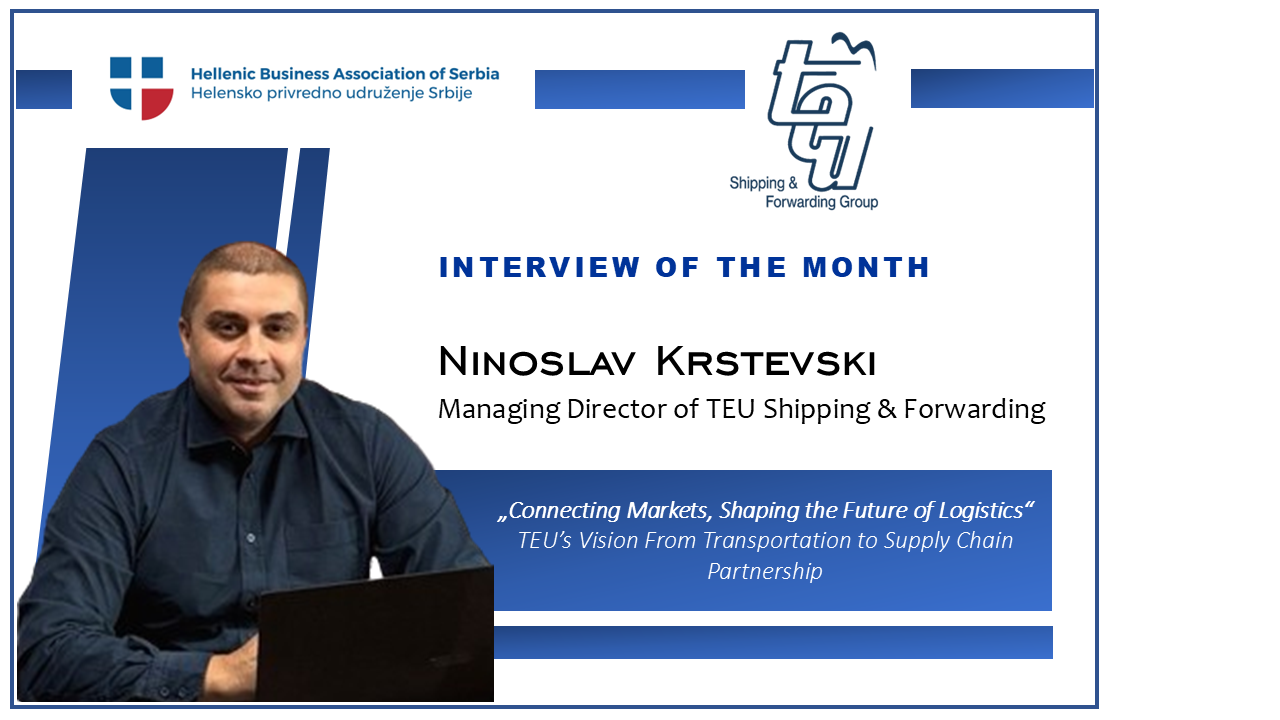
INTERVIEW OF THE MONTH: TEU SHIPPING & FORWARDING
Connecting Markets, Shaping the Future of Logistics
Ninoslav Krstevski, Managing Director of TEU Shipping & Forwarding
TEU Group has evolved since its establishment in Thessaloniki in 2004 into an international company operating across multiple markets, with more than 250 employees and an extensive network of global partners. How is the Group positioned internationally today, and what do you consider its key strengths in the global logistics and transportation market?
Today, TEU Shipping & Forwarding Group combines a strong presence in Southeast Europe with direct access to some of the world’s most important sourcing and transportation markets.From our origins in Thessaloniki, we have expanded across Greece, Bulgaria, Romania, Serbia, Bosnia and Herzegovina, Cyprus and China, while our participation in more than 20 international logistics networks gives us access to partners across 195 countries.
I believe one of our greatest strengths is that we have managed to grow internationally without losing the flexibility and personal approach of an entrepreneurial company. In logistics, size alone is not enough. Customers need reliability, speed, transparency and, increasingly, someone who understands their entire supply chain rather than simply executing one shipment.
Our approach is therefore built around combining local expertise with international reach. Our teams understand their individual markets, while operating as part of one Group and one international network. This allows us to offer integrated solutions across sea freight FCL & LCL, road freight FTL & LTL , air freight, customs, distribution and logistics.
Ultimately, our objective is quite simple: to make complex supply chains easier for our customers to manage.
TEU has been operating in Serbia for several years. How would you assess the company's development in the Serbian market so far, and what would you consider TEU's greatest achievement during this period?
Our development in Serbia has been very strong, but perhaps more importantly, it has been sustainable because it grew organically and gradually. Over the years, TEU Serbia has developed from a growing local forwarding operation into a mature logistics organization capable of serving both Serbian companies and major international customers with increasingly complex supply chains.
Today, our presence includes Belgrade, Leskovac and Nikola Tesla Airport, providing us with the ability to support customers across different transport modes and regions.
However, I would not define our biggest achievement simply in terms of revenue, volumes or geographical expansion. Our greatest achievement has been building credibility. First as an employer and a business entity and gradually as a vendor.
Serbia is a relationship-driven business environment. Customers remember whether you delivered when circumstances became difficult, whether you were available when something went wrong and whether you approached their business as if it were your own. The trust we have established with our employees has been placed forward to our customers and has created the foundation for the next phase of TEU Serbia’s growth. We increasingly see Serbia not only as an individual market, but also as an important logistics hub connecting North East Continent, Central Europe, the Adriatic, the Balkans and the ports of Northern Greece.
TEU provides its customers with a wide range of logistics and transportation solutions. Which services are currently in greatest demand in the Serbian market, and what makes TEU stand out in the way it works with customers and manages their logistics needs?
Serbia is a particularly interesting logistics market because its geography and industrial base create demand across several transport modes.
Road freight remains extremely important because of Serbia’s trade connections with the European Union and neighbouring Balkan markets. At the same time, we are seeing significant demand for ocean freight, particularly for Serbian importers and exporters connecting with Asia, as well as growing requirements for air freight and time-critical solutions in industries where speed is essential. Situation with EU passes for the truckers is creating market shift to air freight or rail freight demand that was not there previously.
Customers are also increasingly looking beyond individual shipments. They want better visibility, more reliable planning and logistics partners that can coordinate several parts of the supply chain.
This is where we try to differentiate ourselves. We do not want our relationship with a customer to begin with a quotation and end with a delivery confirmation. We first try to understand the customer's business: where the cargo originates, where the bottlenecks are, what risks exist and what is most important to their operation - price, transit time, inventory availability, reliability or flexibility. Sometimes the best logistics solution is not the most obvious one. Our role is therefore increasingly becoming that of a supply-chain partner rather than simply a transportation provider. This is also evident from our investment in ISO certifications that is creating added value for our customers.
Global supply chains have faced a series of challenges in recent years, from geopolitical tensions and changing transport routes to disruptions in maritime trade. How have these developments affected the logistics sector, and what do you see as the main challenges facing companies in the industry today?
The biggest change is probably that unpredictability has become part of everyday logistics management. For many years, supply chains were designed primarily around efficiency and cost optimisation. Today, resilience and flexibility have become equally important.
Geopolitical developments, disruptions in maritime corridors, capacity constraints, changing trade flows and volatility in freight rates can affect a supply chain very quickly. A route or sourcing strategy that works efficiently today may need to be reconsidered tomorrow.
For logistics companies, this means that simply having a strong operational network is no longer sufficient. We must be able to react quickly, provide alternatives and communicate clearly with customers when circumstances change. One of the biggest challenges for our industry is therefore balancing three things: cost, reliability and resilience. The lowest-cost solution is not always the solution that creates the greatest value for the customer.
Companies are increasingly asking questions such as: What is our alternative route? How quickly can we switch transport modes? How exposed are we to one port, carrier, border crossing or supplier? The logistics provider of the future will increasingly be expected to help answer these questions.
Digitalisation, automation and the growing demand for faster and more transparent logistics processes are reshaping the way companies manage their supply chains. Which trends do you believe will have the greatest impact on the future of the sector, and how do you expect technology to change the role of logistics companies in the coming years?
Technology will significantly change logistics, but I do not believe that logistics will become less human. It will become more intelligent. The most important developments will be greater real-time visibility, automated workflows, better integration between logistics systems and customers' systems, predictive analytics and, of course, artificial intelligence.
Today, enormous amounts of supply-chain data already exist. The challenge is turning that data into useful decisions. For example, knowing where a shipment is located is valuable. Being able to anticipate a delay, understand its potential impact on production and immediately propose an alternative is considerably more valuable. Automation will also remove many repetitive administrative processes from our industry. This should allow logistics professionals to spend more time on exception management, customer relationships, problem-solving and supply-chain design. For that reason, I believe the role of freight forwarders and logistics companies will gradually evolve. We will move from being primarily transport coordinators towards becoming increasingly important supply-chain intelligence and decision-support partners. Technology will provide the information faster. The competitive advantage will come from what companies do with that information.
As a Greek company operating in Serbia and part of a wider international business network, how do you see the potential for further strengthening business ties between Greece and Serbia? Where do you see the greatest opportunities for cooperation, and what role can organisations such as HBA play in strengthening these connections?
The relationship between Greece and Serbia has always been strong, but I believe there is still considerable room to translate this relationship into even deeper business cooperation.
From a logistics perspective, the two countries are naturally connected. Serbia is an important industrial and distribution market in the Western Balkans, while Greece provides strategic access to the Mediterranean and, through ports such as Thessaloniki and Piraeus, to global maritime trade. This creates significant opportunities in transport, infrastructure, manufacturing, food and agriculture, energy, retail, tourism and broader supply-chain development. As regional trade continues to grow, I believe we will also see greater importance placed on transport corridors connecting Serbia with Northern Greece and the wider Adriatic and Balkan region.
However, successful international business is not built only through infrastructure. It is also built through relationships. This is where organisations such as the Hellenic Business Association can play a very important role. HBA creates a platform where Greek and Serbian companies can meet, exchange knowledge, understand each other's markets and identify opportunities that might otherwise never become visible.
For TEU, becoming a member is therefore not simply about joining another business association. It is an opportunity to become more actively connected with the Greek-Serbian business community and to contribute our own knowledge, network and logistics expertise to its further development. We believe that the stronger the connections between businesses become, the stronger the economic relationship between our two countries will become as well.